Your Customers’ Pain Is the Key to Unlocking Your Magnetic Question
A Twenty-Minute Exercise to Turn What Your Customers Struggle With into a Five-Second Qualification Tool.
By Dan Grech
In this post on “The Magnetic Question,” we told the story of two entrepreneurs who stopped pitching and started asking. Morgan Smith turned a hundred dollars’ worth of fortune cookies and a single question into a fifty-to-one ROI at a trade show. Nicole Klein replaced years of complicated sales training with six words: Do you find exhibiting easy or hard?
Both were using what we call a Magnetic Question — a single, yes-or-no question designed so that your ideal client says “yes.” That yes is the green light. The follow-up is open-ended — What makes it hard? What have you tried? — and suddenly the prospect is telling you their pain points before you’ve said a word about yourself.
The initial closed question qualifies. The open follow-up question converts. When they finally ask what you do, they’ve already told you why they need you.
This post will walk you through a twenty-minute exercise to find yours.
What Makes a Great Magnetic Question
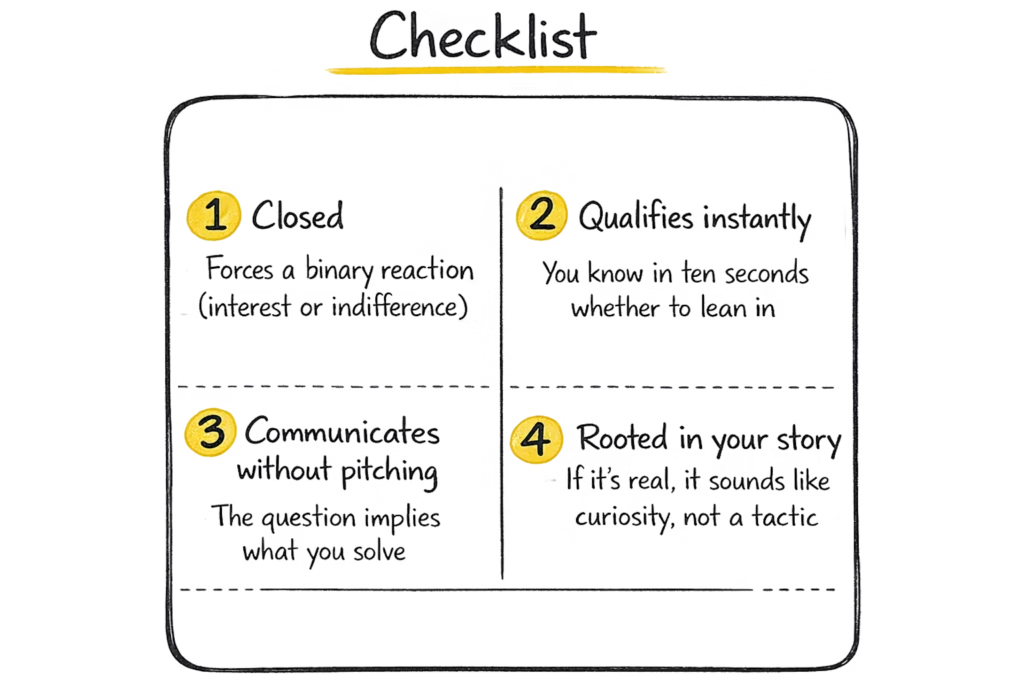
A great Magnetic Question has four qualities.
First, it’s closed, not open-ended. It forces a binary reaction — interest or indifference. Do you find exhibiting easy or hard? is a Magnetic Question. Tell me about your business is not. You’re looking for a yes-or-no question where your ideal client says yes.
Second, it qualifies instantly. The answer tells you whether this person is worth a longer conversation before either of you has invested more than ten seconds. If the answer is yes, you lean in. If it’s no, you smile, wish them well, and move on.
Third, it communicates your offer without pitching. The question itself implies what you solve. Does your company have a purpose beyond profit? tells you I work with purpose-driven businesses. Do you find exhibiting easy or hard? tells you I make exhibiting easier. Is the JobTread software hard to implement? tells you I remove implementation headaches.
Fourth, it’s rooted in your story. This is what separates a Magnetic Question from a sales tactic. A manufactured question sounds like a technique. A question that flows from the real reason you started your business sounds like genuine curiosity — because it is.
Step 1: Name the Core Tension Your Story Resolves
Every business exists to resolve a tension. Something is hard, broken, missing, or painful for your customers, and you make it better. Your job in this step is to name that tension as specifically as you can.
Write this sentence: “My customers struggle with _______________.”
Be specific. Not “marketing” but “telling their story in a way that actually drives sales.” Not “operations” but “running projects without chaos and guesswork.” Not “logistics” but “getting their product to customers without losing money on every shipment.”
The more precisely you name the pain, the sharper your Magnetic Question will be. Vague tension produces vague questions, and vague questions don’t qualify anyone.
If you’ve done the work of uncovering your Childhood Influence Story — the formative experience that shaped why you do what you do — this step is easier than you think. Your business tension almost always maps back to a pattern you first encountered long before you started your company. Morgan’s father ran a plumbing business built on straight talk. The tension Morgan resolves — implementation chaos, vendor confusion, software overwhelm — is a direct extension of that upbringing. Nicole spent her career watching exhibitors struggle with trade shows. The tension she resolves is the one she’s been studying her whole professional life.
But wait — what’s a Childhood Influence Story, and how do you determine yours? That’s a deeper excavation than we can cover here. It’s the subject of a full chapter in my upcoming book, Your Business Is Your Story. For now, focus on the customer pain. That’s your entry point.
Step 2: Turn the Tension Into a yes-or-no Question
Now rewrite your tension as a closed question designed so that your ideal client says yes. The format is simple:
“Do you find [thing your customers struggle with] easy or hard?”
Or: “Does your business have [thing you provide that most lack]?”
Or: “Have you ever [experienced the pain your business solves]?”
The key: your ideal client’s answer should be yes. Yes, it’s hard. Yes, I struggle with that. Yes, I’ve experienced that pain. That yes is the signal that this person is worth a longer conversation. Everything that follows depends on it.
Write three versions. Say each one out loud. The one that feels most natural — the one you’d actually ask a stranger at a networking event without feeling like you’re running a script — is your Magnetic Question.
Step 3: Test the Filter
A Magnetic Question works like a magnet — it attracts and repels. Both forces matter.
For each version, ask yourself: If someone says yes, are they my customer? If someone says no, can I politely move on? If both answers are clear, the question works. If you’d need a follow-up question to know whether they’re a fit, sharpen it.
Remember Nicole’s filter: if someone says exhibiting is hard, she’s in a real conversation. If someone says it’s easy, she congratulates them and asks for a referral. Both outcomes are clean. No ambiguity. No chasing.
Step 4: Plan the Follow-Up
Your Magnetic Question opens the door. The follow-up walks through it.
When your ideal client says yes, the next move is open-ended: What makes it hard? or What have you tried? This is where the real conversation begins. Let them talk. Let them describe their frustrations, their failed attempts, their unmet needs. They’re doing the work of explaining exactly why they need you — and they’re doing it before you’ve said a single word about yourself.
When someone says no, the move is just as important: That’s great — who do you know who might find it harder? One sentence turns a non-prospect into a potential referral source. The people your Magnetic Question repels don’t leave with a negative impression. They leave knowing exactly what you do and exactly who needs it.
Plan both responses before your next event. The yes follow-up should feel like genuine curiosity. The no follow-up should feel like gracious efficiency.
A Twenty-Minute Exercise
That’s the whole process. By setting aside twenty minutes to work through Steps 1 through 4, you’ll have a five-second qualification tool you can test at your next networking event, trade show, or coffee meeting. Here’s a recap:
Minutes 1–5: Name your customer’s core tension. Write the sentence: My customers struggle with _______.
Minutes 5–12: Write three yes-or-no versions of that tension as a question. Say each one out loud. Circle the one that sounds most natural.
Minutes 12–16: Test the filter. Walk through both scenarios — yes and no. Are both answers clear?
Minutes 16–20: Write your follow-up for each answer. Yes: an open-ended question that gets them talking. No: a gracious pivot to a referral ask.
Then test it live. The next person you meet at a business event, ask your question and see what happens. If the right people lean in and the wrong people politely move on, you’ve found it.
Why This Is Strategic
Your business story is a strategic operating system. When you clarify your story, you internalize your value. You stop chasing revenue. You make cleaner decisions. You attract aligned stakeholders and repel misaligned ones.
A Magnetic Question is the micro-deployment of that clarity. It takes your Communications Diamond — the hard center of your origin, purpose, and values — and refracts it through a single facet designed for one specific moment: the opening seconds of a new conversation. A yes-or-no question where your ideal client says yes. An open-ended follow-up that gets them talking. And a gracious exit when the fit isn’t there.
My own Magnetic Question is: Does your company have a purpose beyond profit?
If someone lights up and starts talking about why their work matters, I know I’m talking to a potential client. My follow-up: Do you do a good job communicating that purpose to all of your stakeholders? If they look at me blankly or say “to make money,” I smile, wish them well, and move on. The question works because it’s rooted in my deepest belief: that business should serve a purpose greater than the transaction.
This is story compressed into its most portable form. And it only works when the story underneath it is real.
Why You Can't Always Find It Alone — An Invitation
Here’s what I’ve learned: the Magnetic Question sounds simple, but finding yours on your own is harder than it looks. You’re too close to your own story. The patterns that are obvious to everyone else are invisible to you — the same way Morgan didn’t see “we don’t bullshit clients” as a strategic asset until he excavated it, and Nicole didn’t realize “easier” was doing all the heavy lifting until she stopped overcomplicating the question. Sometimes you need someone outside your story to help you see what’s been there all along.
So let me ask you: Does your company have a purpose beyond profit?
If you’re a purpose-driven founder who knows your business stands for something but struggles to say it in a way that opens doors, I’d love to hop on a call and explore your Magnetic Question and purpose beyond profit together.
Book a Call with Dan → Let’s find the five-second version of your story — the question that attracts the right people, repels the wrong ones, and makes every conversation count.