The Magnetic Question: Five-Second Story Deployment
One question. Five seconds. The right people lean in, the wrong ones walk away.
Your Business Story – why you do what you do and why it matters – is one of your company’s most powerful strategic assets. But you can’t tell a five-minute story to every stranger at a trade show or networking event. You need a way to deploy it in five seconds.
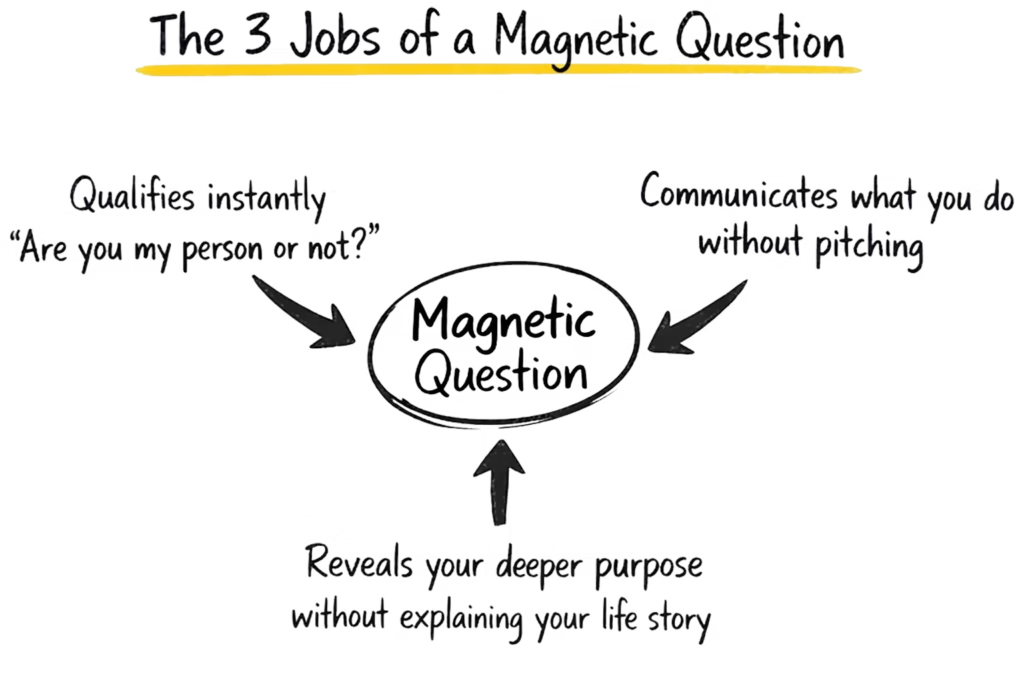
That’s what a Magnetic Question does. It’s a single, yes-or-no question designed so that your ideal client says “yes.” That one word tells you everything: they’re a fit, they have the pain you solve, and the conversation is worth having. Your follow-up is open-ended — What makes it hard? What have you tried? — and now they’re talking, telling you their problems before you’ve said a word about yourself. Five seconds to qualify. Ten seconds to kick off a real conversation.
It’s not small talk. It’s the smallest possible deployment of your business story in the wild. And it works like magic.
The Hundred-Dollar Booth That Outperformed Everyone
Morgan Smith of Smith + Co implements JobTread software for contractors. It’s a B2B software implementation firm—not exactly the kind of business that lends itself to flashy conference marketing.
Morgan grew up in Colorado Springs, where his father worked as a marketing consultant serving general contractors. Around the dinner table, Morgan absorbed lessons about straight talk, earning trust, and never overselling what you couldn’t deliver. His dad taught him one thing above all: don’t BS clients.
That ethic became internalized. Years later, through story excavation work, Morgan crystallized a core operating principle: “We don’t bullshit clients. We meet people where they actually are—at their pain—and we solve the real problem.”
That principle shaped everything about how Smith + Co showed up at the annual JobTread user conference, a gathering of 1,200 to 1,300 contractors.
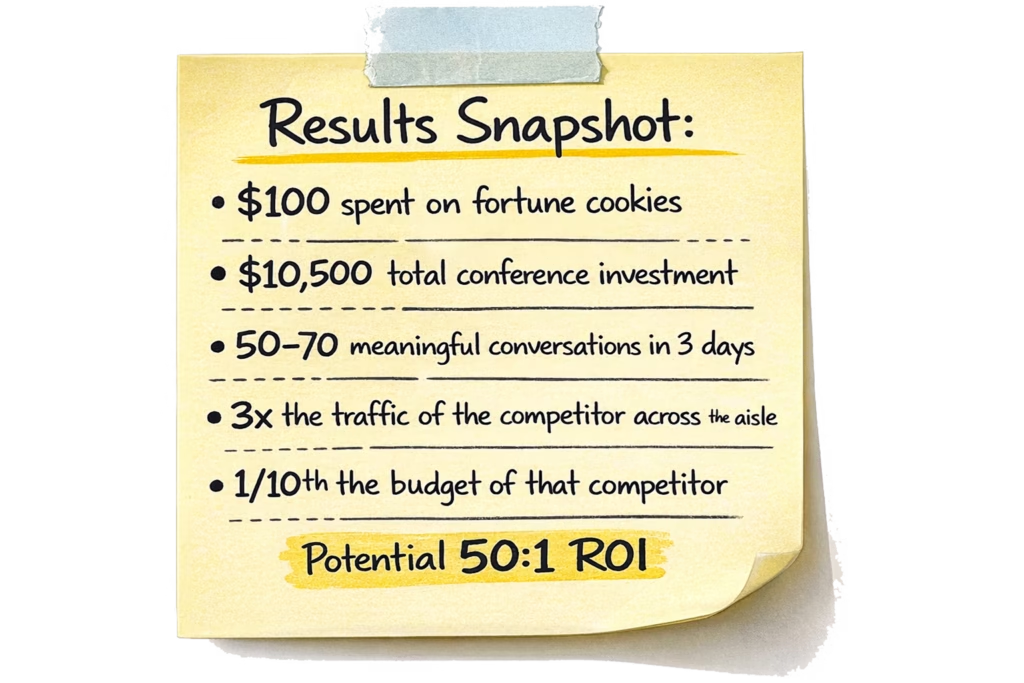
The top-tier sponsorship package was $25,000. Morgan spent $10,500. $8,000 was spent on a smaller package and $2,500 to sponsor a happy hour. His booth was, in his own words, “the most simple booth of all time.” A stand-up banner with the company name. A giant sticky note pad. Small Post-it notes. Markers. And a bowl of fortune cookies with JobTread inside jokes that cost a hundred dollars.
That’s the whole setup. No screens. No demos. No spin-the-wheel gimmicks.
Smith + Co’s Magnetic Question is simple: Is the JobTread software hard to implement? The question is designed so that Morgan’s ideal client says yes. That yes is the green light. The follow-up is open-ended: What’s been the hardest part? Now the prospect is talking — sharing frustrations, naming specific pain points, doing the work of explaining exactly why they need Morgan’s help. Only after they’ve finished does Morgan respond: “Our firm’s purpose is to remove — or at least lessen — the headaches so you can focus on building your business.”
Across the top of the sticky note pad, Morgan wrote an open-ended variation of his firm’s Magnetic Question: What’s your biggest headache with the JobTread software?
Morgan and his team primed the board by posting sticky notes of their own responses first, so visitors knew they could contribute. Their post-its included the most common issues that JobTread clients face, so that passers by could see their common pain points written down. By midday, strangers were stopping just to read what others had written. “Oh yeah, do you have anything to add?” became a natural conversation opener from his sales team. People would stop, scan the board, nod at someone else’s answer, and then stick their own frustration on the wall.
The fortune cookies did the rest. Morgan ordered a hundred and fifty custom cookies from an online vendor with five messages, each targeting a specific pain point his team heard constantly. One read: Your team will always remember to clock out this week. Another: Your vendors will finally use the portal (well, maybe half). The messages weren’t branded. They didn’t need to be. The booth was right in front of the main ballroom, and the cookies went viral at the conference. Attendees started laughing, sharing them, showing them to JobTread’s own staff. People tried to steal them. The team made it a game: add a frustration to the giant pad, get a cookie.
Directly across the aisle, a competitor had two giant high-definition screens running demos. A polished display with ten times the budget.
Morgan estimates his sticky notes and fortune cookies generated three times as many conversations.
In three days, Smith + Co had fifty to seventy meaningful exchanges. Morgan’s sales team was booked with six sales qualification calls every week for the next four weeks. Marketplace inquiries doubled in January, thirty new leads versus a typical fifteen. With a conservative customer lifetime value of $15,000, closing a single client would break even on the entire conference spend. The realistic math, Morgan calculated, was a potential fifty-to-one return.
He never pitched. He asked what hurt, put it on a wall where others could see it, and let people discover he was the one who could fix it.
Here’s the part most people miss: this wasn’t a clever marketing stunt. It worked because it was rooted in Morgan’s story. A marketing consultant son who was raised on straight talk doesn’t waste time on spin-the-wheel games. He asks the direct question. The reaction tells him everything he needs to know. If someone leans in, they’re aligned. If they shrug and walk on, they’re not. No chasing. No convincing. That’s what happens when your story becomes a strategic filter instead of marketing garnish.
Nicole Klein: Simplicity as a Business Philosophy
Nicole Klein runs Exhibit Expressions, a company that helps businesses make exhibiting at trade shows easier and more effective. She knows something most founders miss: booths don’t fail because of bad design. They fail because conversations fail.
Most exhibitors rely on open-ended questions that force the visitor to do the work. Tell me about your business. What are your growth goals for the year? What’s holding you back? These aren’t conversation starters. They’re conversation killers, vague prompts that put the burden on the wrong person.
Through our story work together, Nicole had already refined a new tagline to replace the previous one, “From imagination to implementation,” which she felt was too highbrow for the real conversation she was having with clients. The replacement: We make exhibiting easier. Not easy, easier. Nicole chose the word deliberately. Challenges are inevitable in trade show work. Even she runs into surprises with client programs. The promise isn’t that the difficulty disappears. It’s that someone takes it on for you.
That tagline became the seed of her Magnetic Question: Do you find exhibiting easy or hard?
It’s closed. Binary. Immediate.
If someone says “hard,” Nicole is in a real conversation within seconds. The follow-up is simple: What makes exhibiting hard? And then the prospect is telling her their pain points before she’s said a single word about herself. When they finish venting and finally ask Nicole what she does, she says, “We make exhibiting easier.” By then, they already believe it because she just spent twenty minutes demonstrating that she understands exactly why it’s hard.
Now some people will say exhibiting is “easy.” Nicole can smile and pivot: “Congratulations, you’re one of the few who’ve really nailed it. You’re not a fit for my firm. But if you ever meet someone who finds exhibiting hard, I’d love an introduction.” The non-prospect becomes a potential referral source in one sentence.
This is how the Magnetic Question earns its name. A magnet doesn’t just attract — it also repels. And that repelling force is just as valuable as the pull.
When Nicole’s question draws in someone who finds exhibiting hard, it creates immediate alignment between her purpose and their need. But when it pushes away someone who doesn’t have that problem, it saves both of them from a conversation that was never going to lead anywhere.
Most entrepreneurs waste enormous energy on prospects who were never a fit — chasing polite interest that was never going to convert, following up with people who smiled at the booth but had no real pain to solve. The Magnetic Question eliminates that waste in five seconds.
And here’s what most people miss: the people it repels don’t leave with a negative impression. They leave knowing exactly what you do and exactly who needs it. That clarity turns non-prospects into referral sources, which is often more valuable than the conversation itself.
What struck me most was Nicole’s reflection on why this felt different from every sales approach she’d studied before. Years of reading sales coaching books — the Challenger Sale, Never Split the Difference, Gap Selling, and their descendants — had trained her to make questions unnecessarily complicated. The Magnetic Question gave her permission to be direct. “I think I just made it hard on myself,” she said. The simplicity wasn’t a shortcut. It was the point. And it aligned perfectly with her purpose: she takes on her clients’ challenges and solves them. The question is the first demonstration of that promise.
Why This Is Strategic
Let’s zoom out.
Your business story is a strategic operating system. When you clarify your story, you internalize your value. You stop chasing revenue. You make cleaner decisions. You attract aligned stakeholders and repel misaligned ones.
A Magnetic Question is the micro-deployment of that clarity. It takes the diamond of your business story and refracts it through a single facet designed for one specific moment: the opening seconds of a new conversation. The structure is always the same: a yes-or-no question where your ideal client says yes, followed by an open-ended question that gets them talking. The closed question qualifies. The open question converts. And by the time they ask what you do, they’ve already told you exactly why they need you.
My Magnetic Question
You may be wondering what my firm’s Magnetic Question is. Here it is: Does your company have a purpose beyond profit?
If someone lights up and starts talking about why their work matters — why they started, who they serve, what change they’re trying to make in the world — I know I’m talking to a potential client.
My follow-up is: “Do you do a good job communicating that purpose to all of your stakeholders? To your clients and prospects? To your recruits and hires? To your investors and partners? And most importantly, to yourself? Because that’s what I do. I help founders communicate their purpose in the most powerful way possible to all the people who matter most to their business.”
If someone looks at me blankly or says “to make money”? I smile, wish them well, and move on as fast as I can. They’re not my person, and more importantly, I’m not theirs. No pitch, no convincing, no chasing. That’s the magnet doing its job.
The whole exchange takes less than a minute. And it works because the question is rooted in my deepest belief: that business should serve a purpose greater than the transaction. Anyone who thinks differently is not a fit for me.
The magnetic power of a single question is exactly what Morgan and Nicole discovered. Morgan didn’t just have a good trade show. He had alignment — better conversations, zero misfit leads, deeper trust with the people who actually needed what he sold, all built on a hundred dollars’ worth of fortune cookies and a question that came from his story. Nicole didn’t just simplify her sales pitch. She gave herself a tool that does the qualifying work before the selling work even begins. Neither of them pitched. Neither of them persuaded. They asked, listened, and let the story do the filtering.
That’s not a marketing win. That’s operating system leverage. When your story is clear, your messaging attracts and repels. And when your messaging becomes magnetic, growth compounds — because the right people feel seen and the wrong people self-select out.
Next Up: Find Your Magnetic Question
Morgan’s sticky note wall and Nicole’s binary question look like different tactics. They’re not. They’re the same move: deploy your story as a filter, and let the right people identify themselves. The difference is just format. The underlying principle is identical — and it’s one you can learn. In this post, we’ll walk you through a twenty-minute exercise to develop your own Magnetic Question, step-by-step. We’ll start from the core tension your business resolves and end with a five-second qualification tool you can test at your next networking event, trade show, or coffee meeting. No fortune cookies required (though they don’t hurt).
Why You Can't Always Find It Alone – An Invitation
Here’s what I’ve also learned: the Magnetic Question sounds simple, but finding yours on your own is harder than it looks. You’re too close to your own story. The patterns that are obvious to everyone else are invisible to you — the same way Morgan didn’t see “we don’t bullshit clients” as a strategic asset until he excavated it, and Nicole didn’t realize “easier” was doing all the heavy lifting until she stopped overcomplicating the question. Sometimes you need someone outside your story to help you see what’s been there all along.
So let me ask you: Does your company have a purpose beyond profit?
If you’re a purpose-driven founder who knows your business stands for something but struggles to say it in a way that opens doors, I’d love to hop on a call and explore your Magnetic Question and purpose beyond profit together.
Book a Call with Dan → Let’s find the five-second version of your story — the question that attracts the right people, repels the wrong ones, and makes every conversation count.